
How Sarrai works from question to answer
A conversation with Sarrai always follows the same steps. We explain in detail what workflow is used when handling conversations with Sarrai AI.
Short answer: Sarrai answers customer questions using the knowledge in your knowledge base. When she's not sure, she first asks an internal expert. If no answer comes in time, she hands the conversation to a human. And after a conversation like that, she proposes adding the answer to the knowledge base as an article, so next time she can answer it herself.
The four steps
1. Sarrai answers herself. For the repeatable questions, Sarrai draws on your knowledge base: the published articles, snippets, and sources. The customer gets an answer right away, even outside office hours.
2. When unsure, she checks. If Sarrai isn't certain, she first puts the question to an internal expert through the expert channel. She tells the customer she's just checking, she doesn't make anything up.
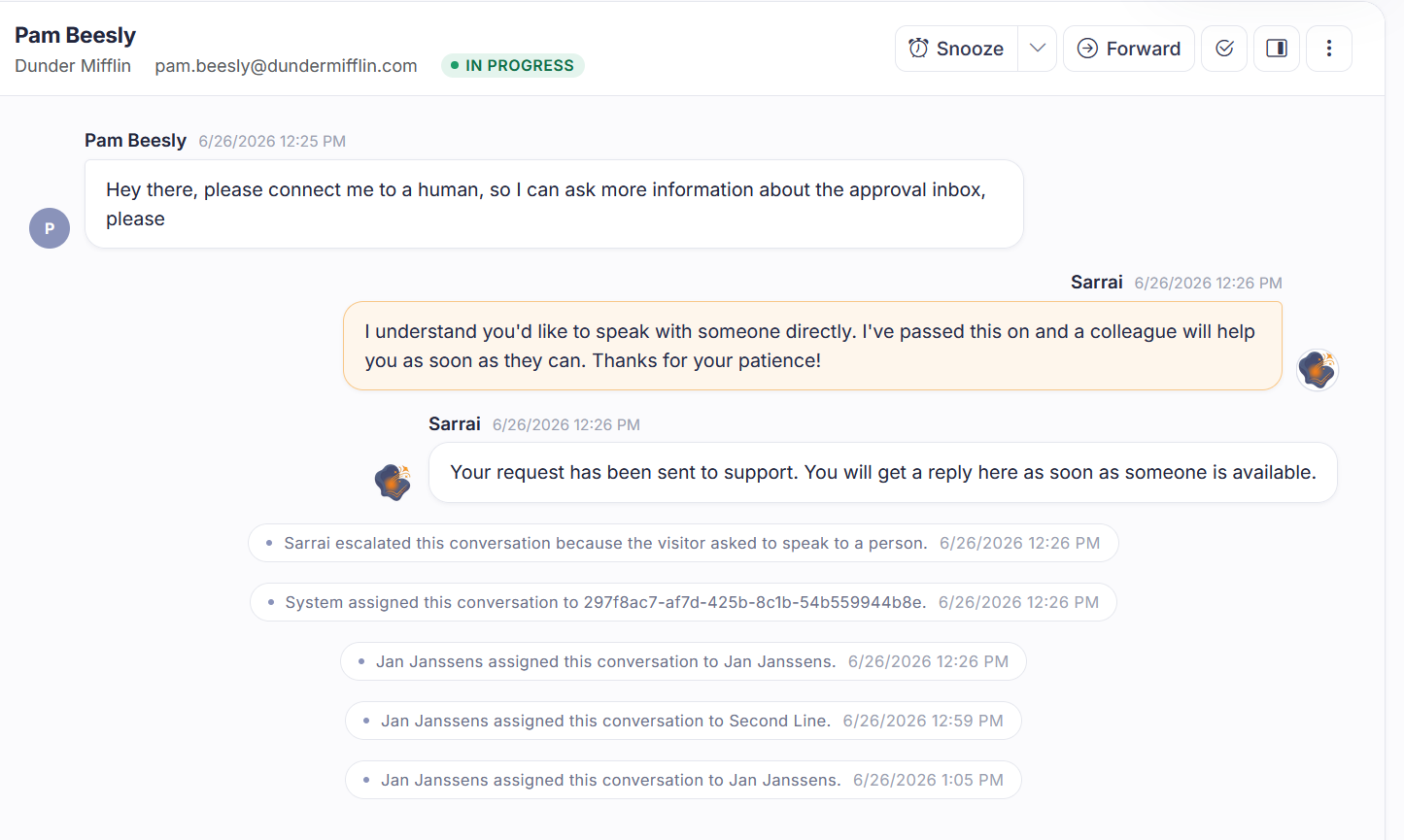
3. If that fails, a human steps in. If she doesn't get an answer from an expert in time, she apologises to the customer and hands the conversation off to the support inbox, where an agent takes over.
4. Then she learns. For a question she couldn't answer herself, Sarrai creates a proposal for a new knowledge base article. You approve or reject that proposal in the approval inbox. Once approved, she can handle that same question herself from then on.
On a vague question she asks back first
"I have a problem" or "it doesn't work" turns up nothing in your knowledge base. A visitor like that used to get the "this falls outside my knowledge" message straight away, which reads as curt while the answer might be sitting in your knowledge base all along.
Sarrai now asks one short clarifying question first, for example what exactly it's about. The visitor's reply starts a fresh search in your knowledge base by itself. Only when asking back doesn't help does she fall back on the out-of-knowledge message.
She doesn't keep pushing: at most two follow-up turns in a row on the same stuck point, and then she falls back. If she gives one normal answer in between, that count starts over. A clarifying question costs you no extra AI turn and isn't billed.
It also doesn't show up in your knowledge gaps report. That's the side effect to keep in mind: if a visitor drops off on the follow-up question, you won't see that conversation there.
Why it's built this way
Sarrai doesn't replace your people. She takes the repeatable work off their plate and keeps the human involved where it matters. Doubt, an urgent tone, or an angry customer are exactly the moments where she brings in a human instead of guessing. And because every unanswered conversation becomes a proposal, the knowledge base gets richer the more you use it.
Good to know
Sarrai only answers with knowledge she genuinely finds in your knowledge base, snippets, or sources. She doesn't make things up from general knowledge. One exception: if you have a connection to your ERP, she may also pull price, stock, and lead time live from it, even when your knowledge base says nothing about them. If an answer isn't anywhere, she asks back, checks with a colleague, or says it falls outside her knowledge. She also answers in the language of the visitor's message, not the language of your helpdesk: if someone types in English in a Dutch chat, they get an English answer.
Two limits can stop her, and they feel different to your visitor. If your subscription is paused or the cap is reached, Sarrai goes completely silent and the visitor gets a generic "sending failed" message, not a "subscription expired" one. If you're on the free plan and your monthly allowance of 50 conversations is used up, the opposite happens: the AI stays out and the conversation goes straight to an agent with the usual handover message. Your visitor notices nothing unusual about it. See How does Sarrai's pricing work?
What still happens after the conversation
Once a conversation is closed, Sarrai reads it one more time to note what it was about and what the customer wanted. That is entirely separate from answering and changes nothing about the conversation. See How does Sarrai classify conversations by topic and question type?
Also searched as
"how does the AI agent work", "does the AI answer everything itself", "what does Sarrai do when she doesn't know", "does the knowledge base learn on its own", "why does the chatbot ask a question back", "the AI asks for details instead of answering"
See also
Was this article helpful?
Your feedback helps us improve this article.
Thanks for your feedback!
